The Room Before the Chamber: How Council Party Groups Set the Whip — and What Residents Can Ask
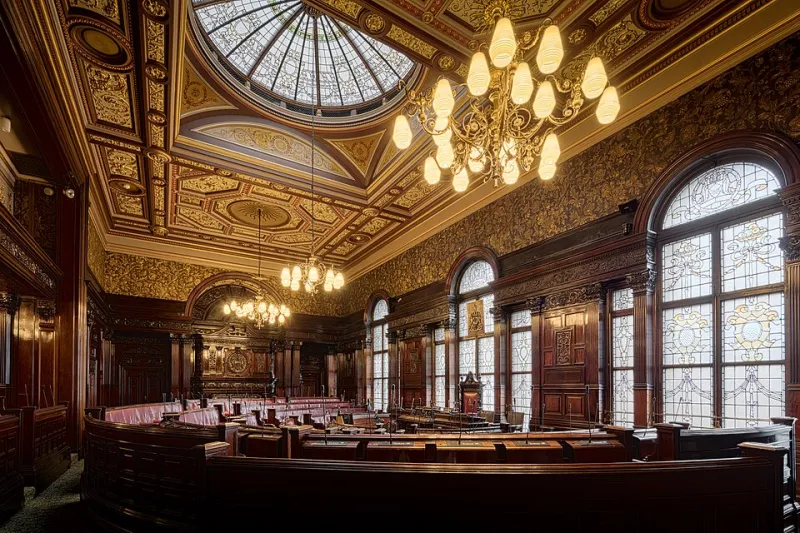
Photo: Michael D Beckwith, CC0, via Wikimedia Commons
Every council has a public chamber and a private rhythm. The public chamber has an agenda, a webcast and a row of seats for residents. The private rhythm is the party group meeting: the room before the chamber, where councillors from the same party settle their position, choose who will speak and agree how they will vote.
Group meetings are not a secret in the sense that nobody knows they happen. They are a secret in the sense that the public is not invited, the minutes are not published and the decisions are not recorded in the council's public papers. That creates an accountability gap at the heart of local democracy. Party organisation is legitimate. But when the most consequential decisions are settled before the public meeting begins, residents are entitled to ask what is being decided, by whom and on what terms.
The meeting you cannot attend
A council meeting is subject to statutory access rules. Notice must be published, papers must be available, and the public has a right to attend, subject to limited exceptions. A party group meeting is not a council meeting. It is a private meeting of a political group. That means the access rules do not apply. The group can meet in a committee room, a pub or a video call. It can decide who speaks on a motion, whether to support an amendment and how strongly to whip its members.
This is not inherently improper. Political parties have always organised. Group meetings allow councillors to coordinate, share information and present a coherent alternative. In a council with no overall control, group leaders may need to negotiate. The problem is not that groups exist. The problem is that their rules, their whip arrangements and their influence over committee places are often invisible to the people who elect them.
What a group is permitted to decide
A group can discuss policy and agree a preferred position. It can choose a group leader and officers. It can decide who sits on which committee, subject to the council's allocation rules. It can agree who will speak in a debate. It can decide whether to impose a whip. These are party decisions, not council decisions. The council decision is made later, in public, when the votes are counted.
The line matters. A group cannot substitute its private vote for the formal vote of the council. It cannot decide a planning application, award a contract or set a budget outside the proper process. If it did, the decision would be vulnerable to legal challenge. But a group can make it politically difficult for a councillor to vote against the party line. That is where the accountability question becomes sharper.
Where legitimate organisation ends and hidden decision-making begins
The distinction is not between party politics and independence. It is between coordination and predetermination. Councillors are entitled to belong to parties, to campaign and to argue for a position. They are not entitled to close their minds before they have heard the evidence. The Localism Act 2011 clarified the rules on predetermination, but it did not abolish the duty to approach a decision with an open mind. A councillor who arrives at a planning committee having been told how to vote, without hearing the case, is not exercising judgment. They are acting as a delegate.
A whip is not automatically a breach of that duty. A councillor can be whipped on a budget and still consider the evidence. But a secret whip makes it impossible for residents to tell the difference. If the public cannot see whether a vote was free or whipped, they cannot judge whether their councillor represented them or simply followed instructions.
Three disclosures that would change the picture
The first is published group rules. Each party group should publish its standing orders: who its officers are, how it selects committee places, how it decides whips and how it handles dissent. These are not state secrets. They are the operating manual of a body that shapes public decisions.
The second is declared whipping. Council minutes could record whether a vote was free or whipped. Some councils already do this. It is a simple reform: a line in the minutes that tells residents whether the outcome was a party decision or a cross-party decision. It does not stop whipping. It makes it visible.
The third is published criteria for committee places. When a group allocates seats on scrutiny committees, planning committees or licensing committees, residents should be able to see the criteria. Are places allocated by seniority, by expertise, by loyalty or by negotiation? The answer matters, because committee places determine who scrutinises what.
What residents can do now
Start with your own councillor. Ask a direct question: were you whipped on that vote, and did you have the chance to argue your case in group? The answer may be illuminating. Ask at public question time. Ask your council to adopt a transparency policy on group rules and whipping. Use freedom of information requests for documents that the council holds about group arrangements, while recognising that purely party documents may fall outside the scope of the Act.
Watch the allocation of committee places after the next annual meeting. Look at who chairs scrutiny and who sits on planning. Ask whether the pattern reflects expertise or party control. These are not arcane procedural questions. They determine whether scrutiny has teeth.
The open-mind test
The test for a healthy council is not whether parties disagree in public. It is whether councillors arrive at the public meeting with minds that can still be changed. A group that publishes its rules, declares its whips and explains its committee allocations is not weaker. It is more accountable. The room before the chamber will always exist. The question is whether residents are allowed to know what happens inside it.